
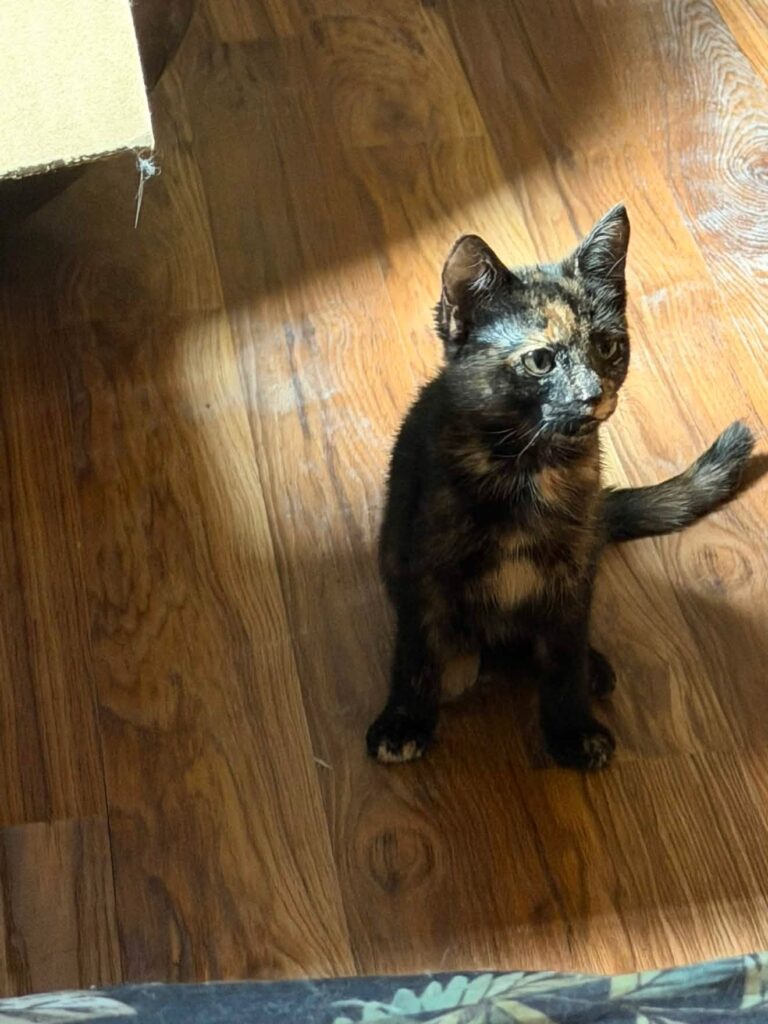
Eerie was found outside by a woman who posted about her online — a last effort before taking her to a shelter, because she could see the kitten had a problem she didn’t know how to handle. Her current owner had experience with pets with mobility issues and went to get her. Today Eerie lives with her and with Lou, another rescue.
The diagnosis wasn’t simple
At first, they thought “wobbly cat syndrome” — the common name for cerebellar hypoplasia, a congenital and permanent condition affecting balance. But an exam also found a severe ear infection, which was treated.
After treatment, Eerie started falling about half as much as before. A real improvement — but not a full cure: she still doesn’t attempt to jump or catch herself when set down, even past three months old.
It’s a case worth documenting exactly because of that mix: part of the problem was treatable (the infection), part may be permanent (the hypoplasia). Only a vet can tell the two apart — partial relief after treatment doesn’t mean balance will fully normalize on its own.
What changes at home, in practice
Low-sided litter box
Eerie doesn’t use the same box as the household’s other two cats — the sides are too high for her to get in. She needed her own, low-entry box. During the antibiotic course, they also added a puppy pad underneath, because accidents increased in that period.
A flat food bowl
She struggles with dry food and a deep bowl — once her face sinks in, someone has to stir the food back up for her to keep eating. A flat or low-sided bowl solved it.
Stairs — then a second set
To get onto the couch and lie with the adult cats, Eerie uses pet stairs. She could claw her way up a couple of times early on, but couldn’t get back down — the stairs solved both directions. Her owner just ordered a second set, for the bedroom, so Eerie can get onto the bed without having to “scream” for someone to pick her up.
The real cost
By the owner’s own account: roughly $15 in adaptations (bowl, litter box, pad) and $90 for the extra vet visit with antibiotics. Nothing that required a renovation or specialized expensive gear — just targeted adjustments using ordinary pet products.
Day to day
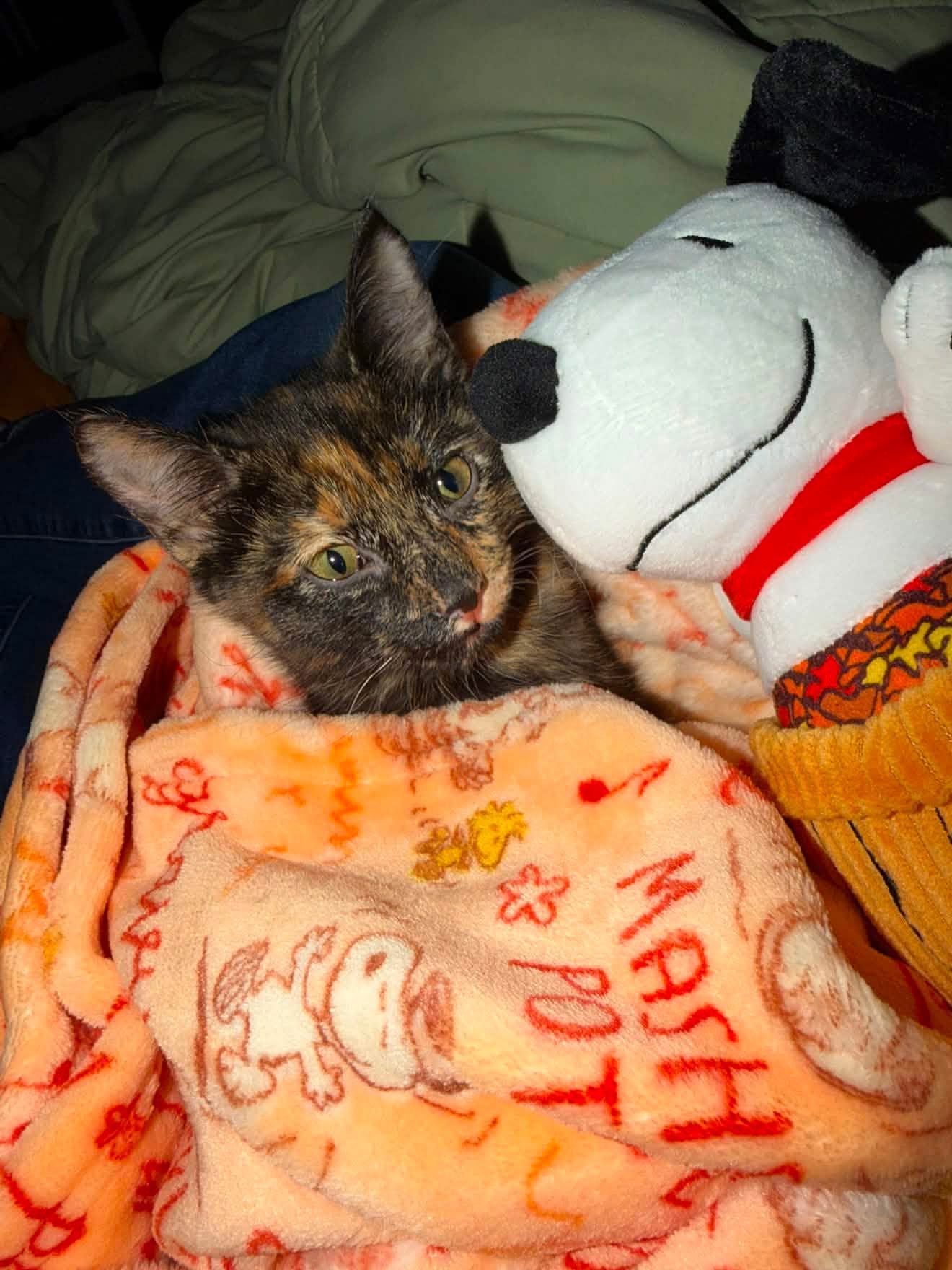
She likes to be wrapped in her blanket to sleep, and wants to snuggle either with the humans or with Lou, the other rescue. The two play hide and seek, and Lou lets Eerie win on purpose. Otherwise she behaves like any kitten — she only bites when she wants something out of reach.
“I feel like you get that a lot from animals that have been abandoned and overlooked, or have issues you figure out — they’re extra happy to see you. Eerie’s purr literally vibrates her whole body. If you have the opportunity to help one, it’s 100% worthwhile.”
— @eeriewobbles, Eerie’s owner
If your cat is losing its balance too
Eerie’s story leaves a practical lesson: before accepting it as “just how she is,” it’s worth checking for a treatable cause — ear infections and other vestibular conditions can mimic cerebellar hypoplasia, and only a vet exam tells them apart. Even when part of the picture is permanent, the adjustments at home tend to be simple and inexpensive.
Frequently asked questions
Is there a cure for wobbly cat syndrome?
Cerebellar hypoplasia (the most common congenital cause) has no cure, but it’s neither painful nor progressive — cats learn to compensate over time. Treatable causes, like ear infections, can improve significantly or resolve with the right treatment. Only a vet can tell them apart.
Do I need expensive gear for a cat with balance issues?
In Eerie’s case, no — a low-sided litter box, a flat bowl and pet stairs did it, all ordinary products at low cost.
Does cerebellar hypoplasia cause pain?
It’s not a painful condition. The challenge is mobility and coordination, not pain — most cats have a normal quality of life with small environmental adjustments.
Is it worth adopting a cat with special needs?
It’s a personal decision, but it usually asks for less than people expect — as Eerie shows, it’s mostly environment adjustment, not constant treatment.