
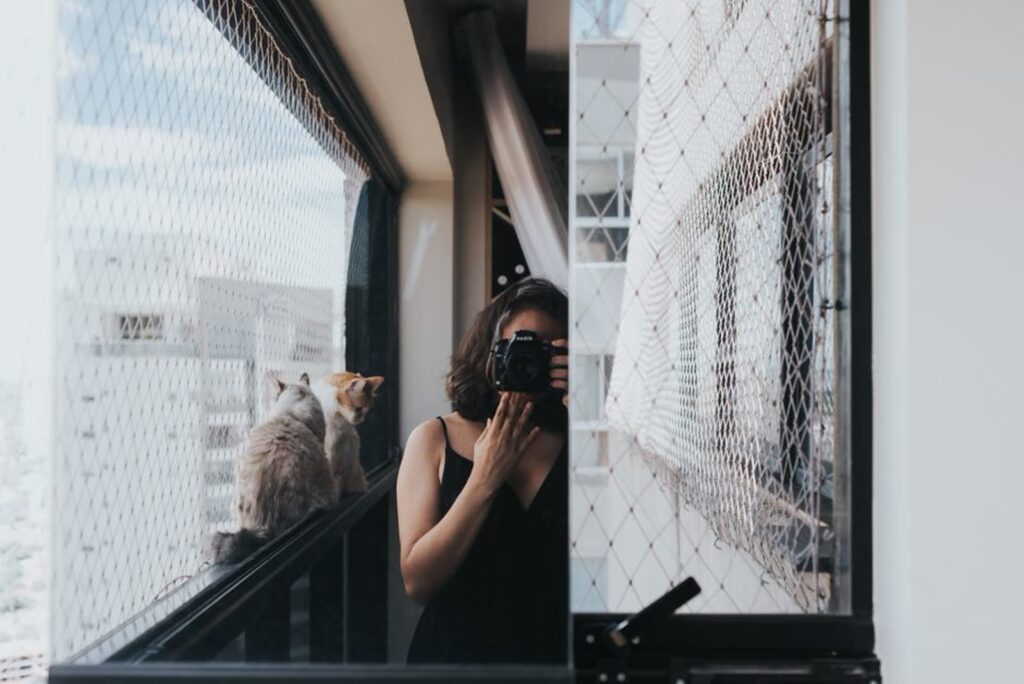
You’ve decided to screen the windows. Then you discover there’s nylon mesh, polyester mesh, steel mesh, balcony netting, removable screens with velcro, with magnets, with fixed frames — and every installer swears theirs is the only safe one. The differences are smaller than they look in three respects, and enormous in one.
What actually separates a good screen from a bad one
It isn’t the mesh material. It’s the fixing. A cat doesn’t tear polyester mesh with a paw: they push, climb and put their whole weight on one corner. What gives way is almost always the edge, not the middle.
So when you compare options, look first at how the thing attaches to the wall — and only then at everything else.
Framed screen (the most reliable)
The mesh is tensioned in an aluminium profile screwed into the masonry, not into the window track. This is the option that holds an adult cat hanging off it.
For: survives weight and shoving; visually discreet; lasts years.
Against: professional installation; holes in the wall, which complicates renting; can’t be removed for cleaning.
Balcony netting
Polyethylene strands tensioned on a steel cable, anchored around the opening. It’s the standard for large balconies and irregular shapes.
For: covers large areas; cheap per square metre; lets more light through.
Against: the mesh needs to be 1.2 inches or smaller for cats. Netting sold as “child safety” usually has larger gaps — a child can’t get their head through, a kitten can.
Removable screens (velcro, magnets, pressure-fit)
Designed for renters or anyone who can’t drill.
For: DIY install; leaves no marks; inexpensive.
Against: this is the one that fails most. Velcro releases in heat and humidity, and magnets give way in exactly the scenario that matters — the cat putting their full weight on at once. Treat it as an extra layer, never the only barrier at height.
Steel mesh
Metal mesh, usually chosen when you also want a barrier against break-ins.
For: practically indestructible.
Against: expensive; noticeably darkens the room; rusts near the coast unless it’s stainless.
What installation actually costs, and why the range is so wide
The price gap between a DIY removable kit and a professionally framed screen isn’t just markup — it reflects genuinely different amounts of work. A framed screen means measuring each opening precisely, fabricating or cutting an aluminium profile to size, drilling into masonry (which takes longer and costs more on concrete or brick than on drywall), and correctly tensioning the mesh so it doesn’t sag into a hammock shape. Balcony netting scales with area, so a wraparound balcony costs meaningfully more than a single window, and irregular shapes (an L-shaped balcony, one with balusters in the way) add labor even when the total square footage is small. Removable screens are the cheapest precisely because none of that skilled labor is involved — you’re paying for material and hardware, not installation time. If you’re budgeting across multiple windows, it’s usually worth getting one professional quote for the whole apartment rather than per-window, since a lot of the cost is the technician’s travel and setup time rather than the materials themselves.
Installation mistakes that quietly create an opening
Most screen failures trace back to a handful of repeatable mistakes rather than a bad product. A mesh that’s tensioned too loosely sags in the middle, and a sagging mesh behaves like a net rather than a wall — a cat’s weight pulls the slack toward the weakest edge instead of being spread evenly, which is exactly the load a loose fixing can’t handle. Corners and the top edge near a window’s opening mechanism are the other common failure point: if the screen has to flex every time the window opens and closes, the fixing at that hinge point wears faster than the rest of the frame and should be checked more often. And on balconies specifically, furniture placed against the railing on the outside of the netting effectively builds a staircase over the barrier — worth walking the perimeter and removing anything a cat could use as a step up and over.
Quick comparison
| Type | Safety | OK for renters? | Best for |
|---|---|---|---|
| Framed | High | No (drilling) | Apartment windows |
| Netting | High if mesh ≤1.2in | No | Balconies, large openings |
| Removable | Low to medium | Yes | Ground floor, extra layer |
| Steel | Very high | No | Security plus safety |
Frequently asked questions
What mesh size is safe for cats?
Gaps of 1.2 inches or less between strands. Above that, kittens and slim cats can push their head through, and where the head goes the body follows.
Will a velcro screen hold an adult cat?
Not reliably at height. Velcro loses grip with heat and humidity, and failure comes precisely when the cat lands their full weight on it. Use it only as reinforcement.
Can I install it myself?
Removable kits, yes. Framed screens and netting require drilling and correct tensioning — a slack screen becomes a hammock and pulls away at the edge.
Do screens darken the room?
Black polyester barely affects light and almost never affects airflow. Steel mesh darkens noticeably.
Do I need screens if I live on the ground floor?
The fall risk disappears, the escape risk doesn’t. A frightened or unneutered cat can vanish for days, and outside there are cars, dogs and disease.
How often should an installed screen be checked?
A quick visual check every few months is enough for a well-installed framed screen — look at the corners and any spot the mesh has to flex. Removable screens are worth checking more often, since velcro and magnets degrade with heat and humidity well before they visibly fail.