
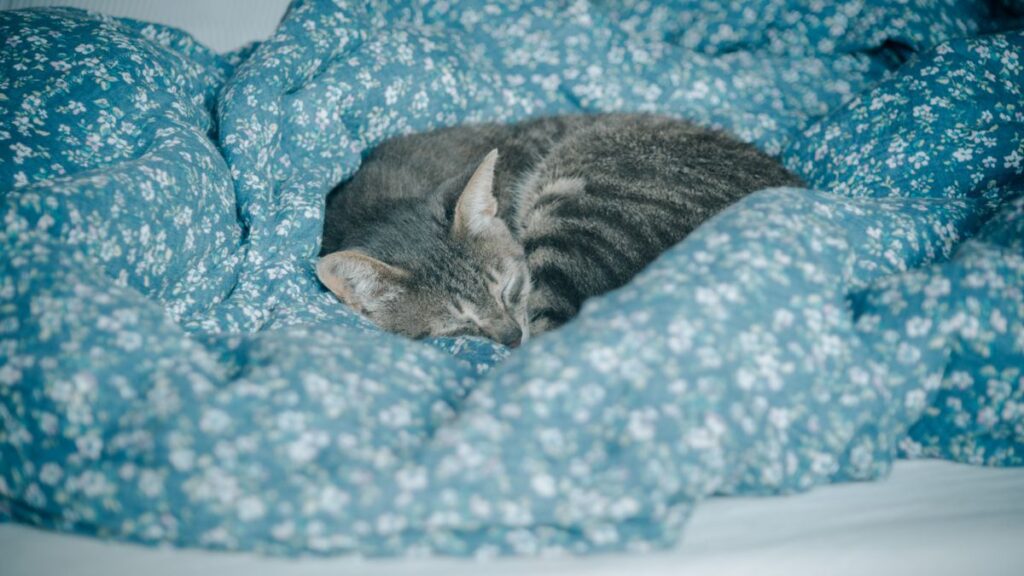
Walk into any pet store and the cat bed aisle looks like it was designed to confuse you. Donuts, caves, hammocks, heated pads, flat mats. The truth is that the right bed has almost nothing to do with which one looks nicest and almost everything to do with how your cat already sleeps. Here is how to narrow it down before you spend money on something that ends up as a rug.
Start by watching how your cat sleeps
Spend a few days paying attention to your cat’s default sleeping shape. It tells you exactly what to buy.
A cat that curls into a tight ball wants walls. A donut bed with a raised rim or an enclosed cave gives it something to press against, which is where it feels safe. A cat that sprawls flat on its side or back wants space, so a flat open mat or a large rectangular bed with low sides suits it better. Force a sprawler into a small donut and it will sleep next to it instead of in it.
Match the bed to your cat’s age and temperature
Kittens and young cats generate plenty of heat and rarely need a warm bed. Older cats are the opposite. Stiff joints respond to gentle warmth, so a senior cat often takes to a heated bed faster than anything else you can offer. If your cat is always hunting for warm spots, on the router, in a sunbeam, on top of the fridge, that is a clear vote for some kind of heat, whether a low-wattage heated bed or a no-cord self-warming mat.
Think about where it goes before you buy the size
A bed only works if it sits where your cat already wants to sleep. Measure that spot. A huge bed that cannot fit on the windowsill your cat loves is a wasted purchase. Cats also like height and a view, so a bed near a window or up off the floor usually beats one tucked in a corner.
Prioritize washable
Every cat bed gets fur, dander, and the occasional hairball. The single feature that decides whether a bed lasts a year is whether you can throw it in the machine. Beds with removable covers or fully washable construction stay usable. Beds that fall apart in the wash get thrown out. Check this before anything else.
What about material
Plush and shag fabrics feel cozy and most cats love them, but long-haired cats leave fur woven into them. Felt and wool caves resist odor and hold their shape but usually need hand washing. There is no perfect material, so weigh softness against how much cleaning you are willing to do.
The common shapes, and the mistake people make with each
Once you know your cat’s general sleep style, it helps to know where each shape tends to go wrong, because the failure mode is rarely the shape itself.
Donut and bolster beds fail most often on sizing. Buy one too small and a cat that likes to curl still cannot fully turn around inside it, so it perches on the rim instead of settling in. Buy one too large and it loses the point, the raised edge stops being close enough to press against. Measure your cat curled into its usual ball and match the bed’s inner circle to that, not to the cat’s stretched-out length.
Enclosed caves fail on placement more than size. A cave with a single entrance pushed into a tight corner can backfire with a nervous cat, because part of what makes an enclosed bed feel safe is a clear escape route if something startles them. Give a cave a little open space in front of the entrance rather than wedging it into a dead end.
Window hammocks and perches fail on hardware. Suction-cup mounted hammocks are rated for a specific weight, and an adult cat landing on one with any momentum puts more force on it than its resting weight suggests. Check the weight rating against your cat’s actual weight with some margin, and inspect the suction cups periodically rather than assuming they will hold indefinitely.
Flat orthopedic mats, the kind aimed at senior cats, fail when they are too thin. A mat marketed for joint support needs real cushioning underneath, not just a soft cover over thin padding, or it does nothing for a cat with arthritis beyond a slightly softer floor.
Buying for a multi-cat household
If you have more than one cat, the calculation changes. Cats that are not closely bonded generally do not want to share a sleeping space, even if they get along fine while awake. Resource guarding around sleeping spots is common and quiet, you may not see overt conflict, you will just see one cat always winning the good bed and the other one on the floor.
A reasonable rule of thumb from most cat behavior guidance is to provide at least as many beds as you have cats, ideally one or two more, spread across different rooms and different heights rather than clustered in one spot. Mixing styles helps too: a donut for the cat that curls, a flat mat for the one that sprawls, a perch for the one that likes to watch the room. This also reduces the odds that a shy cat gets muscled out of the only good sleeping spot in the house by a more confident housemate.
Once you know your cat’s sleep shape, age, and the spot the bed will live in, the choice gets simple. If you want concrete picks sorted by exactly these needs, see our roundup of the best cat beds for every sleep style.
Frequently asked questions
What size cat bed should I get?
Big enough for your cat to curl up comfortably, but cozy enough to feel secure. For curlers, snug is good. For sprawlers, measure your cat stretched out and add a few inches.
Do cats even need a bed?
They will sleep fine without one, but a dedicated bed gives them a warm, safe spot of their own, which matters more for older cats, cold homes, or anxious cats that want an enclosed place to hide.
How many cat beds do I need for multiple cats?
A common guideline is one bed per cat plus one extra, placed in different rooms and at different heights. Cats that are not bonded usually prefer not to share a sleeping spot, even in friendly households.