
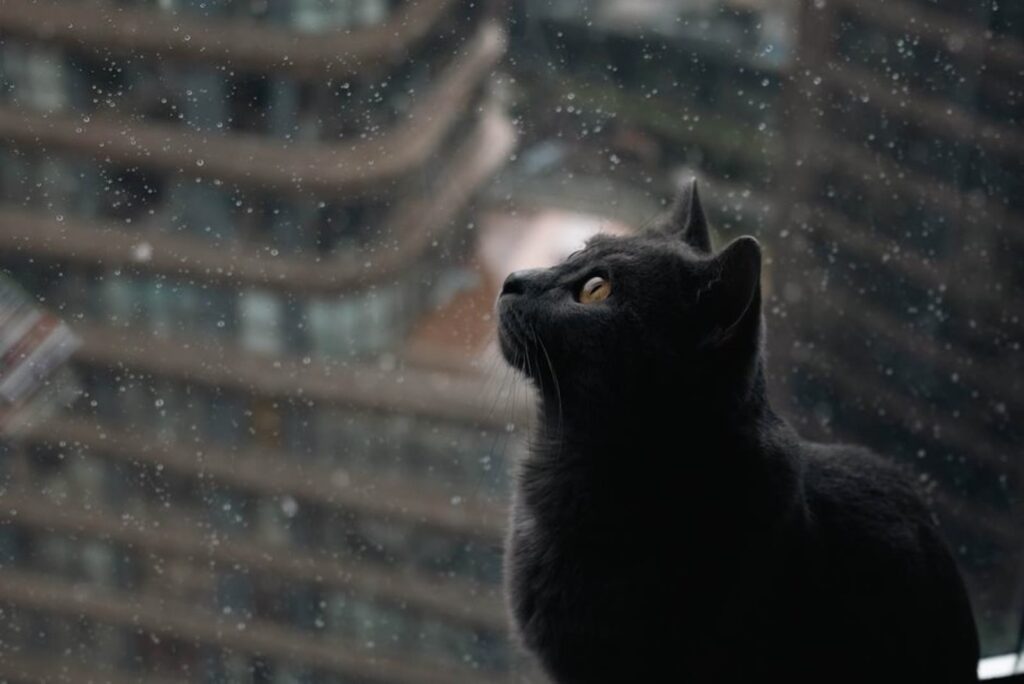
Everyone repeats that cats always land on their feet. They do — the reflex is real and it works. What almost nobody mentions is that landing on your feet doesn’t prevent fractures, and that falls from windows are one of the most common emergencies in city veterinary practice. It has a name: high-rise syndrome.
What high-rise syndrome is
It’s the pattern of injuries typical of a cat falling from height, usually from a window, balcony or ledge. The term comes from a 1987 paper in the Journal of the American Veterinary Medical Association that followed 132 cats treated after falls in New York. Around 90% survived once they received treatment.
The injuries repeat in a recognisable pattern: chest trauma, fractured jaw and hard palate, broken teeth, and limb fractures — mostly the front legs, which absorb the impact first.
Why cats get it wrong if they have a righting reflex
The righting reflex is real. The cat senses rotation through the inner ear, twists the front of the body, then the rear, and arrives feet-down. It can do all that in under half a second.
The problem isn’t orientation, it’s energy. Landing feet-first spreads the impact better, but it doesn’t remove it. From a sixth floor a cat hits the ground at over 55 mph — no posture solves that. And there’s a detail that changes the picture: cats rarely jump out of a window on purpose. They slip while chasing a bird or an insect, and an unplanned fall doesn’t give the reflex time to finish.
The figure that looks wrong: the middle floors
The 1987 study found something counterintuitive — cats that fell from more than seven storeys had, on average, less severe injuries than those falling from intermediate heights.
The proposed explanation is that once terminal velocity is reached, the cat stops accelerating, relaxes and spreads its legs horizontally, like a parachutist. That increases drag and distributes the impact across more of the body.
One honest caveat, which rarely travels with the statistic: the study only counted cats that arrived alive at the clinic. Cats that died on impact were never in the sample. The number describes survivors, not the real risk of falling from the twentieth floor. There is no safe height.
Screening windows properly
1. Framed pet screen
The most reliable option for apartment windows. The mesh is tensioned in an aluminium profile fixed to the wall, not clipped into the window track. It’s what survives an adult cat hanging off it.
2. Balcony netting
Covers large openings where a framed screen doesn’t apply. Check the mesh: for cats the gap between strands needs to be small enough that a head can’t pass — kittens get through spaces that look impossible.
3. The three places everyone forgets
Bathroom windows, utility-room vents, and the gap around a window-mounted air conditioner. These three come up again and again in fall reports, precisely because they look too small to matter.
If your cat does fall
Go to the vet even if they seem fine and walk away from it. Chest trauma and internal bleeding often show no external sign in the first hours, and cats have a strong instinct to hide pain — inherited from animals that couldn’t afford to look vulnerable.
Signs that need urgent care: fast or laboured breathing, open-mouth breathing, pale gums, bleeding from nose or mouth, refusing to put weight on a leg, or hiding in a tight space and not coming out.
To transport, use a rigid carrier and avoid handling the spine. If you suspect a fracture, move them as little as possible.
Frequently asked questions
Do cats really always land on their feet?
Almost always, thanks to the righting reflex, which works from about a foot of height. But landing on their feet doesn’t prevent fractures: the impact is still absorbed by the front legs, chin and chest.
What height is dangerous for a cat?
Anything above one storey can cause injury. There’s no threshold below which a fall is safe, and the study showing fewer injuries from very high falls only counted cats that survived to reach a clinic.
Do neutered cats try to jump out less?
Neutering removes the escape drive tied to mating, which is one cause. It doesn’t remove curiosity or the urge to chase birds and insects, which is the more common trigger.
Do screens block airflow?
Polyester pet mesh barely reduces airflow — far less than most people expect. The noticeable effect is on light, not ventilation.
My cat never goes near the window. Do I still need screens?
Yes. Falls almost never happen because the cat wanted to jump — they happen because of a slip mid-chase. Normal behaviour doesn’t predict the day a bird lands on the ledge.