
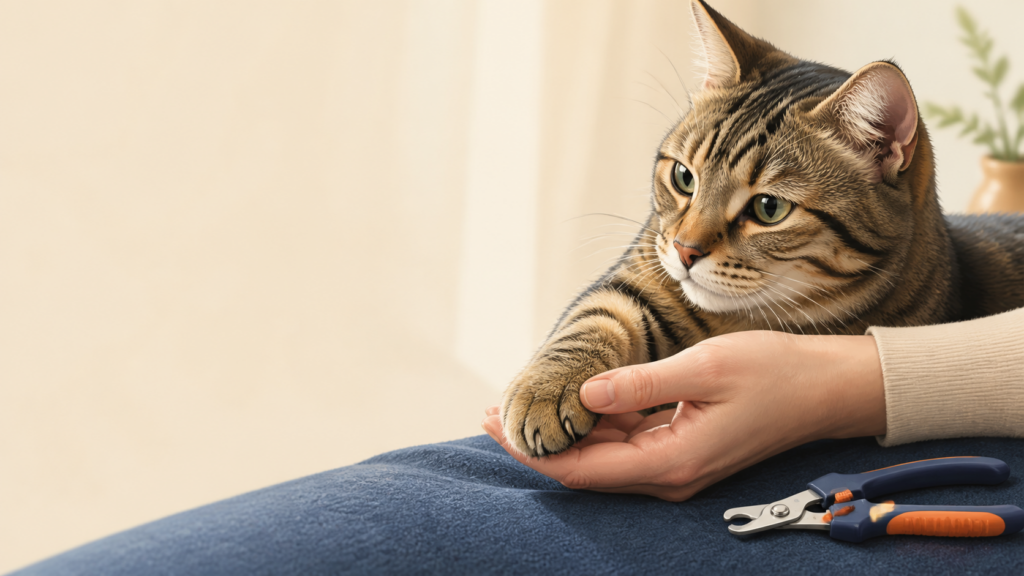
Trimming your cat’s nails doesn’t have to turn into a wrestling match. For a lot of indoor cats, regular claw maintenance is the difference between shredded furniture and a calm, comfortable pet — and it’s a genuinely useful skill to have before you ever need it. The good news is that, with the right tools, a little patience, and some tasty distractions, most cats will tolerate (and some even accept) a nail trim at home.
Quick answer: Trim only the sharp tip, work in tiny sessions, and stop before your cat becomes frightened. The goal is a calm routine, not one perfect session.
This guide walks through cat claw anatomy, why indoor cats especially need trims, and a repeatable step-by-step method you can build into a routine. Nothing here requires special training — just a steady hand and a cooperative cat (or a very good treat).Fast Facts
- Cats have 18 claws total — 5 on each front paw and 4 on each back paw.
- The “quick” is the pink living part inside the nail; cutting it causes bleeding and pain.
- Most cats need a trim every 2–4 weeks, but senior cats may need more frequent checks.
- The dewclaw (the thumb-like nail on the inner front leg) never touches the ground and wears down the least.
- Never use human nail clippers — cat-specific clippers give a cleaner, safer cut.
- Keep styptic powder or cornstarch nearby in case you nick the quick.
Why Nail Care Matters (and What’s Inside the Claw)
A cat’s claw is made of layered keratin, the same protein as your own nails. The visible outer shell is dead tissue and safe to trim. Running up the center of each claw, though, is the quick — a bundle of blood vessels and nerves. On a light-colored claw you can usually see it as a pink triangle; on a dark claw it’s invisible, which is why you always cut conservatively on black nails.
There’s also the dewclaw, a small claw set higher on the inner side of the front leg. Because it never contacts the ground, it doesn’t wear down naturally and is the one most likely to curl into a spiral and embed in the paw pad if ignored. Older cats, which often scratch less vigorously, are especially prone to this.
Overgrown claws aren’t just a furniture problem. When a claw grows long enough to curve under, it can press into the pad and cause pain, infection, and changes in how your cat places its feet. A scratching post helps cats shed the outer sheath and stretch their muscles, but it doesn’t replace an actual trim — the living nail keeps growing regardless.
Why Indoor Cats Need Regular Trims
Outdoor cats wear their claws down on bark, soil, and pavement. Indoor cats don’t get that natural filing, so their nails grow longer and sharper between trims. If you’ve started finding little “click-clack” sounds on the kitchen floor, or caught your cat shredding the couch more than usual, long claws are often part of the story. Keeping them short is one of the simplest ways to protect both your cat’s paws and your furniture — and it pairs well with giving them a proper vertical or horizontal scratcher they actually like.
The Step-by-Step Method
1. Set the scene. Pick a calm moment — after a meal or a play session, when your cat is naturally a bit sleepy. Sit somewhere comfortable with the cat in your lap, or have a helper hold a squirmier cat.
2. Choose the right tool. Small scissor-style clippers and guillotine-style clippers are both common; many owners prefer the scissor style for control. Avoid human clippers, which can crush rather than cut. If you’re unsure what fits your grip, a well-reviewed pet brand isn’t the issue here — any cat-specific clipper from a pet store will do.
3. Extend the claw. Gently press the top and bottom of the paw pad between thumb and finger to push the claw out. Don’t squeeze hard — just enough to expose it.
4. Locate the quick. On light claws, cut only the clear/white tip beyond the pink. On dark claws, take off just the very tip and check the cross-section; if you see a dark dot in the center, stop — you’re near the quick.
5. Make the cut. Snip straight across the translucent tip at a slight angle. Aim to remove only the sharp point, not the whole curved nail.
6. Don’t forget the dewclaw. Check the inner front legs each session; these are easy to skip and the most likely to overgrow.
7. If you nick the quick. Stay calm — it bleeds and stings but isn’t an emergency. Apply styptic powder or a pinch of cornstarch and gentle pressure. Your cat will forgive you faster if you do.
8. Reward and repeat. A lickable treat (the squeeze-tube kind works well) during and after the session builds a positive association. If your cat tolerates only one or two paws at a time, that’s fine — finish the rest later.
FAQ
Can I use human nail clippers on my cat?
It’s not recommended. Human clippers are shaped for flat fingernails and tend to crush or split a cat’s curved claw, which is more painful and harder to control. A small cat-specific clipper gives a cleaner cut.
How often should I trim my cat’s nails?
Most cats do well on a 2–4 week schedule. Senior cats and indoor cats who don’t scratch much may need checks more often, since their claws grow without natural wear.
My cat absolutely hates nail trims — what do I do?
Go slow. Desensitize by handling paws daily without clipping, use high-value treats, and trim one paw per session. If it stays genuinely stressful for both of you, a groomer or veterinary clinic can do it quickly — and a sturdy cat tree plus regular scratching outlets will at least slow the regrowth between professional trims.
This article is general care guidance, not a substitute for veterinary advice. If your cat’s claws look infected, bleed on their own, or your cat is in pain, contact your vet.