
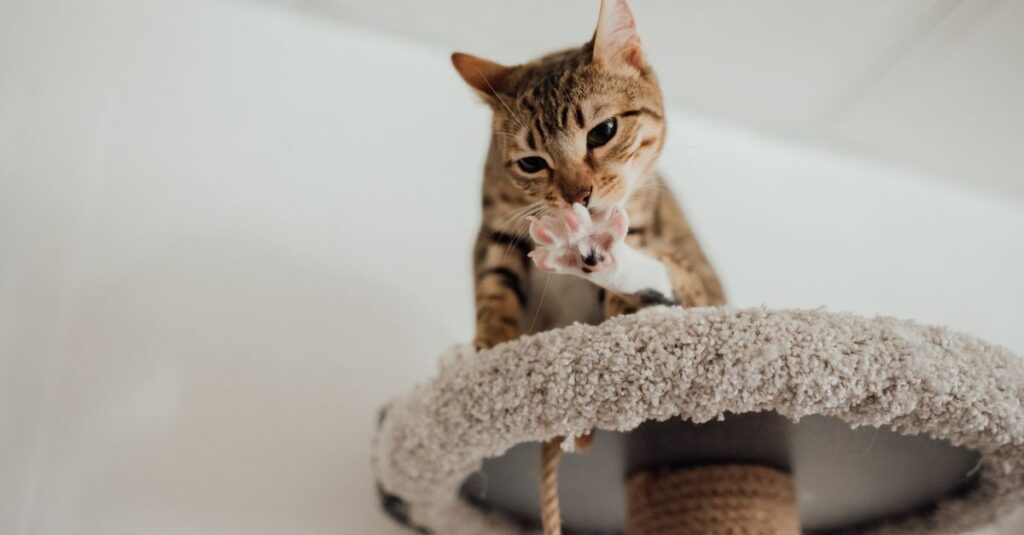
Bought a nice scratcher and your cat ignored it completely? It is probably the wrong type. Cats have a clear preference between scratching upright or lying down, and getting that right solves half the couch problem.
Vertical scratchers
These are the posts and towers, where the cat stands on its back legs and stretches up. Most cats like them, because it mimics scratching a tree trunk. The golden rule is height: tall enough for a full stretch, and sturdy enough not to wobble. A post that shakes scares the cat off.
Horizontal scratchers
These are the pads and ramps on the floor, often made of cardboard. Some cats prefer to scratch lying down or on an angle, and those cats will love it. They tend to be cheaper and take up less space, so they are great for testing before you invest in a tower.
How to find out what yours prefers
Look at where it already scratches. If it attacks the side of the couch standing up, go vertical. If it rakes the rug lying down, go horizontal. When in doubt, offer both for a week and see which gets more use. It is cheap to find out and saves you from a tower it will ignore.
What about material?
Sisal is usually the favorite, because it has the texture cats love to shred. Pressed cardboard also works and is cheap. Plain carpet works less well and can confuse the cat, which may start scratching your actual rug by association.
The short version
There is no absolute best, just the best for your cat. A tall, sturdy vertical suits most, while a sisal or cardboard horizontal suits floor-scratchers. Find the preference and you fix the couch problem for good.
Test stability before you trust it
A scratcher that even slightly wobbles under a determined scratch will get abandoned fast, because a cat mid-stretch is vulnerable and instinctively distrusts anything unsteady underfoot. Before assuming a cat “doesn’t like” a vertical scratcher, press down hard on the top corner yourself and see if it rocks or tips. A wall-mounted vertical scratcher solves this permanently, since it cannot tip regardless of base weight, and works well for cats that scratch near doorways or corners already. For freestanding posts, a heavier, wider base always beats a taller post with a flimsy one.
Angled scratchers split the difference
Between a straight-up post and a flat floor pad sits the angled or ramp-style scratcher, propped at roughly 30 to 45 degrees. It suits cats that scratch on an angle naturally, like the arm of a couch or a slanted headboard, and it is a reasonable pick if you are not sure yet which way your cat leans. Watching how a cat actually approaches a target tells you more than guessing: a cat that rises fully onto its hind legs before scratching wants vertical, one that drops down and rakes with its body low wants horizontal, and one that scratches at an angle on furniture arms is telling you to try the angled version.
Surface area counts more than people expect
A scratcher that is too narrow or too short forces a cat to scratch in an awkward, cramped position, which makes it less satisfying even if the material is right. For vertical posts, width matters as much as height, a post a cat can wrap its whole body around invites a fuller stretch than a thin pole. For horizontal pads, length matters the same way, a short pad only fits a few strokes before the cat’s paws run off the edge. When a scratcher gets ignored despite the right orientation and material, undersized dimensions are worth checking before assuming the cat simply does not like it.
Frequently asked questions
My cat ignores the scratcher. Did I buy the wrong one?
It might just be in the wrong spot. A scratcher hidden in a corner is useless; cats scratch where they mark territory, near where they live and sleep. Move it next to the couch or a walkway.
Sisal, cardboard, or carpet?
Sisal lasts longest and most cats prefer it. Cardboard is cheap and many cats love it, but it sheds crumbs. Carpet confuses them (it feels like your rug). When in doubt, sisal.
Do I need both vertical and horizontal?
If the budget allows, yes. Many cats use both at different moments: vertical for the big wake-up stretch, horizontal mid-play.