
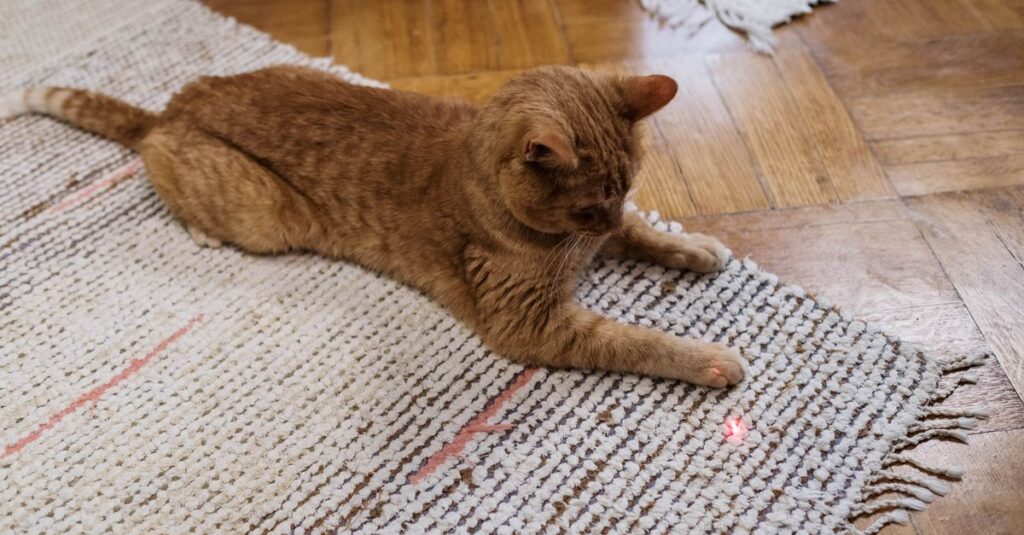
The two best-selling cat toys are opposites: one is light that never becomes real “prey” in the mouth, the other is texture the cat can actually bite and feel like it “won” at the end. That difference explains why some cats love one and completely ignore the other.
Short answer: feather toys tend to satisfy the full hunting instinct better (stalk + chase + bite). Laser hooks young/hyper cats faster, but can be frustrating long-term since it never delivers a physical “reward” at the end.
Laser: pros and cons
For: fast, unpredictable movement triggers the chase instinct better than almost anything else. Great for burning off energy quickly in young/hyper cats, and you don’t need to be up close (handy on a hot day).
Against: the cat never actually “catches” the laser — without that final bite, some behaviorists point out it can build frustration with very frequent use. Always end a laser session by letting the cat “catch” a real physical toy, to close out the hunting cycle.
Feather: pros and cons
For: real texture the cat bites, claws, and “kills” at the end — completes the whole hunting cycle (stalk → chase → capture). Tends to hold interest longer in older or calmer cats.
Against: feathers shed and cats can swallow bits of fluff — pick models with feathers sewn on, not glued. Movement is more predictable than laser (not always a downside, some cats actually prefer that).
Why the “unfinished hunt” matters more than it sounds
The stalk-chase-catch sequence isn’t just a cute way to describe cat play — it’s the actual predatory sequence a cat’s brain is wired to complete, and cutting it off partway through has a real effect on some cats. A laser that just switches off after ten minutes of chasing, with nothing physical ever caught, can leave a highly driven cat wound up rather than satisfied — pacing, vocalizing, or redirecting that leftover energy onto a housemate’s tail or your ankle on the way past. This doesn’t happen to every cat, and plenty of cats play with lasers their whole lives with no issue at all, but if you notice a cat getting worked up rather than calm after laser sessions, that’s worth paying attention to. The fix is simple and doesn’t mean giving up the laser: finish every session by tossing a plush mouse or dragging a feather toy somewhere close enough to catch, so the last few seconds of play end in an actual capture.
Which to pick for your cat
- Young/hyper kitten: laser, for quick energy burn — always finish with a physical toy.
- Adult/calm cat: feather, satisfies the full cycle better.
- Senior cat or vision issues: feather — laser demands quick visual reflexes a senior cat may not have anymore.
- Not sure yet: get a 2-in-1 (laser + feather in the same toy), a good way to find out the preference without buying both.
A simple routine that uses both
You don’t have to pick one permanently. A routine that works well for a lot of cats: open with 2-3 minutes of laser to get the cat moving fast and burn off the initial burst of energy, then switch to a feather wand for the last 5 minutes so the session builds toward an actual catch. End by letting the cat hold and “kill” the feather toy for a few seconds before you put it away — that closing moment is what signals to the cat that the hunt is over, rather than just interrupted.
FAQ
Is laser bad for cats?
Not physically, as long as you never point it directly at the eyes. The real concern is psychological: always end the session by letting the cat “catch” something real, so the hunting cycle doesn’t stay unfinished.
Can I use a laser and feather toy in the same play session?
Yes, and it’s a good approach for cats that love the laser but never get a physical payoff — start with the laser, then transition to a feather or plush toy for the final minutes so the session ends in a real catch.