
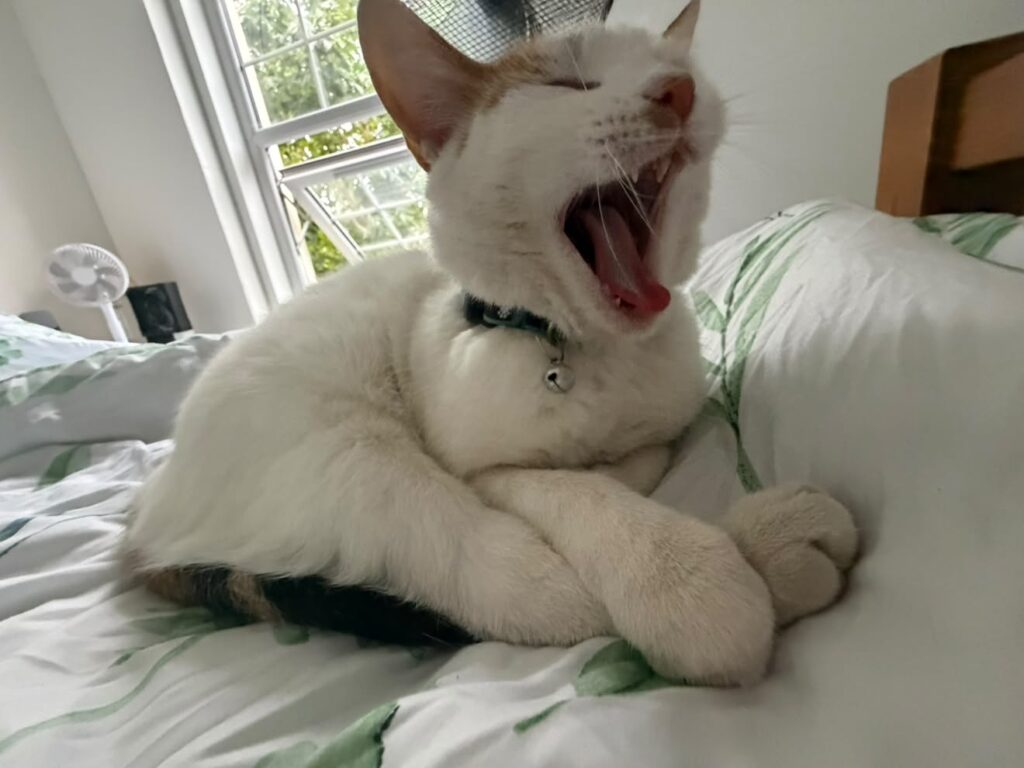
Luna’s owner describes her in one line: “cheeky, knows the difference between a toe and a toy.” That single sentence carries the whole answer most people are actually looking for when their cat nips them mid-play — the biting itself isn’t the problem. Whether the cat has learned to control it is.
Play biting vs. real aggression
Cats don’t have hands, so their mouth and claws do a lot of the exploring — a soft, controlled nip during a play session is normal cat vocabulary, not a warning sign. What actually matters is the read on the whole cat, not the bite alone:
- Ears and body: forward or relaxed, not flattened sideways or against the head.
- Pressure: a quick nip that doesn’t break skin, versus a hard, held bite.
- What happens after: a cat that bites playfully lets go and keeps playing; a stressed or scared cat locks on, or bites and bolts.
- Tail: a gentle flick or swish is normal excitement; a tail thrashing hard side to side is not.
A cat like Luna — one who nips a toe but not hard enough to hurt — is actually demonstrating something called bite inhibition: she knows how much pressure is too much. That’s a learned skill, not an accident.
Why cats bite during play in the first place
It’s predatory instinct with the volume turned down. Stalking, pouncing, and biting are the same sequence a cat would use to catch prey — play is how kittens and adult cats practice it safely. Kittens who were allowed to bite hands freely (instead of toys) growing up tend to carry that habit into adulthood, simply because nobody ever redirected it.
How bite inhibition is actually learned
Kittens learn most of their bite control from each other, long before they ever meet a human hand. When a kitten bites a littermate too hard during play, the littermate yelps and stops playing — an immediate, consistent consequence that teaches “that was too much” far more effectively than anything a person can replicate after the fact. Kittens separated from their mother and littermates very early, or raised alone without other cats to play-fight with, sometimes miss out on a chunk of that lesson and can bite harder as adults simply because nobody ever pushed back at the right moment. This is worth knowing mainly because it reframes a hard-biting adult cat as under-taught rather than “mean” — the same redirection techniques below still work, they may just take longer and more consistency to stick.
How to redirect it, starting today
- Never use your hand as a toy. Even in fun, it teaches a kitten that skin is a fair target. Use a wand toy so there’s always distance between your hand and the bite.
- Stop the second it happens — no yelling. A short, quiet “ow” and withdrawing your hand for a few seconds teaches the same lesson a littermate would: biting ends the fun.
- Redirect immediately to something they’re allowed to bite. Keep a soft kicker toy or plush within reach; the moment they nip, put it in front of them instead of pulling away empty-handed.
- Give the predatory instinct a real outlet. A daily 10-15 minute wand-toy session that ends in an actual “catch” tires out the exact instinct that shows up as biting the rest of the day.
Getting everyone in the house on the same page
Redirection only works if it’s consistent, and consistency breaks down fast when one person in the house still wrestles with the cat’s mouth for fun while everyone else is trying to discourage it. It’s worth a quick, explicit conversation with everyone in the household — including kids, who are often the ones a cat bites hardest simply because quick, jerky hand movements are the most exciting thing to chase. Teaching children to freeze rather than yank a hand away, and to use a toy instead of fingers to play with the cat, does more for reducing bites than almost anything aimed at the cat itself. A cat that gets mixed signals — hands are off-limits with one person, a fun toy with another — takes noticeably longer to learn the boundary than one getting the same message everywhere.
When it’s worth a closer look
Occasional, gentle mouthing during play is not something to fix — it’s normal cat behavior, and many cats (Luna included) never grow out of it entirely, they just learn to keep it soft. What’s worth watching for is a change: a cat that suddenly bites harder, bites outside of play, or bites and won’t let go can be signaling pain, stress, or a change in the home worth investigating with a vet.
Frequently asked questions
Should I punish my cat for biting during play?
No — punishment (spraying water, tapping the nose) tends to make cats bite-shy and secretive rather than gentler, and can damage trust. Redirection works better and faster.
Will my cat grow out of play biting?
Some do, many just get softer with it over time, the way Luna has. The goal isn’t zero mouth contact — it’s a cat that knows a toe isn’t a toy, gently.
Is play biting different in kittens than adult cats?
Kittens bite more and harder simply because they’re still learning bite inhibition, the same way puppies do. Consistent redirection during the kitten months is what shapes a gentler adult cat.