
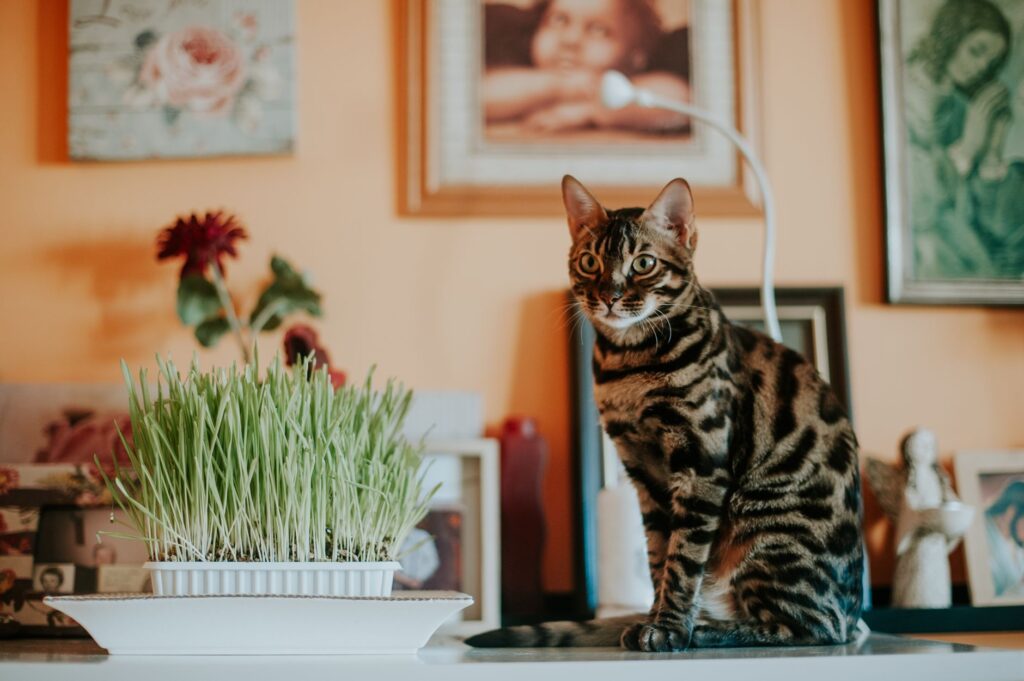
Cat grass kits are one of those small products that show up on a owner’s radar for surprisingly scattered reasons. One person buys one because their cat keeps chewing the houseplants; another because the cat has taken an interest in the seed packet on the windowsill; another because a friend mentioned it and the idea of growing something specifically for the cat felt oddly considerate. By the time the kit arrives, the question has usually shifted from “should I get this?” to “what exactly am I supposed to do with it, and is it doing anything?”
The honest answer is that cat grass is a simple product with a narrow, specific purpose, and the claims around it sometimes outrun what is actually going on. A kit is usually a small container of seeds — most commonly wheatgrass, oat grass, or a blend — with a growing medium and instructions for sprouting it indoors. The grass is meant to be offered to the cat as something to chew, and that is essentially the whole product. What the grass does for a given cat varies, and that variation is where the confusion lives.
Fast Facts
- What they are: A packaged set of seeds (usually wheatgrass, oat grass, or barley), a growing medium, and instructions for sprouting a small patch of grass indoors for a cat to chew.
- Most common varieties: Wheatgrass, oat grass, barley grass — sometimes sold as a blend.
- What they are for: An indoor chewing option for cats who show interest in grass or greenery; a substitute for off-limits houseplants in some households.
- What they are not: A medicine, a guaranteed digestive solution, a replacement for veterinary care, or a product with uniform effects across cats.
- Cat grass vs. catnip: Different plants entirely. Catnip is a member of the mint family and affects many cats with a behavioral response (rolling, chewing, excitability); cat grass is a cereal grass that cats chew for different reasons and does not produce the same kind of response.
Want to compare kits? You can see cat grass kits on Amazon. Treat cat grass as an enrichment option, not a medical treatment, and follow the product instructions.
What Cat Grass Actually Is
The name “cat grass” is descriptive rather than botanical. It is not one species; it is a category of fast-growing cereal grasses that are easy to sprout indoors and are marketed for cats to chew. The most common is wheatgrass — the same plant that shows up in human juice bars, grown here for a different audience and a different purpose. Oat grass and barley grass are similar in use and in how they are grown.
The reason these particular grasses are used is mostly practical. They sprout quickly, tolerate the small containers the kits are sold in, and put out edible shoots within a window that fits a household’s patience. They are also non-toxic in the sense that a cat chewing a small amount is not ingesting something dangerous — which is not the same thing as saying the grass is doing something medically meaningful every time a cat eats it.
That distinction matters. A cat who nibbles a little grass and then goes back to normal behavior has not necessarily received a treatment; the grass may simply have been something to chew. A cat who regularly eats large amounts of grass and then vomits, or who eats grass compulsively, is a different situation and one that is worth paying attention to rather than treating as a solved problem by the presence of a grass kit.
Why Cats Chew Grass
Cats chewing grass is common enough that most owners who have had a cat for any length of time have seen it. The reasons are not fully settled in a single neat explanation, and that is worth stating plainly rather than reaching for the one-line answer that sounds decisive.
One fairly common observation is that grass provides something a cat’s normal indoor diet may not. Grass contains fiber, and fiber affects digestion in the broad sense that fiber affects digestion in many animals. In some cases, owners notice their cat chewing grass and then passing hair or other material that had been sitting in the digestive tract. In other cases, the cat chews grass with no obvious result at all. Which of those a given cat does is not predictable from the fact of chewing alone, and owners should be cautious about assuming a specific mechanism from a single observation.
Another common observation is simpler and harder to dismiss: some cats just seem to like the texture or the act of chewing greenery. Chewing is a behavior with its own satisfactions, and grass is something a cat can mouth, tear at, and chew in a way that a kibble or a soft food generally does not permit. For a cat whose diet is otherwise entirely soft or processed, the opportunity to engage in that kind of chewing may be part of the appeal. This is not a dramatic claim; it is closer to the everyday logic of enrichment.
A third possibility is that grass-chewing is one of the things cats do that is partly exploratory and partly habitual. Cats are persistent investigators of their environment, and a low pot of green growth on the windowsill is, from a cat’s perspective, a new object with a texture, a smell, and a behavior attached to it. Some cats investigate once and lose interest. Some return to it regularly. The range is normal.
What is worth avoiding is the confident story that every cat who eats grass is “cleansing” something or that grass is a reliable digestive fix. Those claims turn up in advertising and casual advice, but they overstate what is broadly known. A cat grass kit is better understood as a safe chewing option and a low-stakes enrichment item than as a medical tool with consistent effects.
Cat Grass vs. Houseplants: The Practical Reason Many People Buy a Kit
One of the most common reasons cat grass kits exist at all is that a lot of houseplants are not safe for cats to chew. That is the blunt version, and it is the version worth keeping in mind before treating a cat’s interest in greenery as something to just leave alone.
A cat who has discovered that the plant on the shelf is chewable may not be able to tell, on its own, that some plants are fine in small amounts and others are not. The owner’s job is to make that distinction for them. A cat grass kit gives the cat something green and chewable that is intended for that purpose, which is one way of reducing the odds that the cat will turn to the less suitable plant nearby. That is a practical use of the product and does not require any claim about what the grass does internally.
The limitation is that a grass kit does not, by itself, solve a chewing problem. A cat who is determined to chew houseplants will sometimes do so even with grass available; a cat who is chewing plants out of boredom may need more than a grass pot to address the underlying issue. And a cat who is eating plants excessively, or in a way that seems compulsive, is a situation to watch rather than to hand off to a grass kit and forget. (For more on one common angle on that kind of behavior, see Bored Cat: Signs to Watch and What to Do.)
Using a Cat Grass Kit
Most kits are straightforward to use: sow the seeds in the medium, keep them moist, wait for them to sprout, and offer the grass once it is growing. The specifics vary a little by kit — some include soil, some use a soil-free medium, some are designed for repeated sowings — but the general shape is the same.
A few practical points are worth making because they come up often enough to be worth stating in advance:
- Freshness matters more than people expect. Once the grass is growing, it does not stay in good shape indefinitely. Yellowing, drying out, or becoming slimy are signs that the grass is past its useful point. A cat offered grass that has gone off is being offered something less appealing and less clean than the product was meant to be. Replacing the batch before it deteriorates is part of using the kit well.
- Wash hands and keep the growing area reasonable. A small indoor pot is not a laboratory, but the same basic logic applies: dirt, moisture, seeds, and a cat’s mouth all in the same small system are a reminder to keep things tidy. The cat should not be drinking standing water from the tray, for instance, and the pot should not be sitting in a place where it gets knocked over and left wet.
- Offer it as an option, not a requirement. A cat who ignores the grass is not necessarily doing anything wrong. Some cats take to it immediately; some sniff and walk away; some return weeks later. The grass is an offered resource. Forcing attention onto it tends to be counterproductive and is not part of the intended use.
- Pay attention to quantity. A small amount of grass is the expected use. A cat who sets to work on a pot as if it is a meal, or who consumes an entire patch in a way that seems intense or compulsive, is not the same as a cat who takes a few nibbles. Owners who see the latter should pay attention to whether the behavior is repeated and whether it is accompanied by vomiting, lethargy, or a change in appetite.
What Cat Grass Is Not
It is worth being explicit about the boundaries of the product, because marketing language sometimes blurs them.
Cat grass is not a substitute for veterinary care. A cat who is vomiting repeatedly, who is not eating, who seems unwell, or whose behavior around grass or plants has changed sharply is a cat worth checking rather than a cat whose symptoms are explained away by the presence of a grass kit.
Cat grass is not universally effective as a digestive aid. Some owners report that their cat seems to benefit from having it available; some notice no particular effect. Both observations are consistent with the product being what it is: a safe chewing option that may or may not have a noticeable effect in a given household.
Cat grass is not catnip, and it should not be treated as if it is. Catnip produces a behavioral response in many cats that is distinctive and fairly well recognized; cat grass does not. Confusing the two leads to disappointed expectations — either a cat who ignores the grass and is presumed “not responsive,” or a buyer who expects a catnip-style reaction and is puzzled when none appears. (For the food side of the broader picture, see Wet vs Dry Cat Food: Which Is Better? and How Much Should You Feed a Cat Per Day?.)
How to Think About Whether a Kit Is Worth It
The useful question is not “does cat grass work?” in the abstract, because the answer depends on what “work” means in a given household. A better set of questions is more concrete:
- Does the cat show an interest in chewing greenery, houseplants, or anything else it would be better not to chew?
- Is there a safe, indoor option the cat can be offered instead?
- Is the household willing to replace the grass when it loses freshness, rather than leaving an old pot around indefinitely?
- Is the cat’s interest in grass a casual one, or a compulsive-looking one that is worth paying closer attention to?
If the answer to the first two is yes and the answer to the last is “casual,” a kit is a reasonable small purchase. If the cat is showing an intense or repeated obsession with eating plant material, or if the eating is paired with other symptoms, the grass kit is not the place to stop thinking about it.
A Note on Cats and Fiber More Broadly
Cat grass sits in the larger, less tidy territory of what cats get from plant material and how that fits into an otherwise meat-oriented diet. Cats are obligate carnivores in the sense that their nutritional needs are built around animal-based nutrition; that does not mean they never interact with plant material, and it does not mean every plant interaction is meaningless. It does mean that plant material is not the backbone of a cat’s diet, and anyone suggesting otherwise is overstating the case.
For owners thinking about diet more broadly, the grass kit is a side issue, not a core one. The main nutrition decisions — what to feed, how much, whether wet or dry suits a given cat — are separate from the small question of whether a pot of wheatgrass on the sill is a useful addition. (For those broader questions, see How Much Should You Feed a Cat Per Day? and Wet vs Dry Cat Food: Which Is Better?.)
FAQ
Is cat grass safe for all cats?
Cat grass made from wheatgrass, oat grass, or barley grass is generally considered a safe thing for a cat to chew in small amounts, in the sense that it is not toxic and is intended for that use. That said, “safe” is not the same as “the cat should eat as much as it wants.” A cat who eats an entire pot in one sitting, or who vomits repeatedly after chewing grass, is a situation to watch rather than a normal result to expect. Kittens and cats with existing health issues should be treated with the same caution as any dietary change: reasonable amounts, attention to how the cat responds, and a call to a vet if something seems off.
How long does cat grass take to grow?
Most kits are designed to sprout within a few days and to be ready for the cat to chew within roughly a week to ten days, depending on the variety and the conditions. The exact timing varies, and the instructions included with the kit are the best starting point. Once grown, the grass is best used while it is still green and fresh rather than left until it yellows or dries out.
Will cat grass stop my cat from chewing my houseplants?
A cat grass kit can help in some households by giving the cat a safe plant to chew instead, but it is not a guaranteed solution. Some cats will happily use the grass and leave the other plant alone; others will use both; others will ignore the grass entirely. If the cat is persistently chewing houseplants despite having grass available, the underlying issue may be boredom, habit, or something broader than the absence of an alternative plant. (For more on that angle, see Bored Cat: Signs to Watch and What to Do.)