
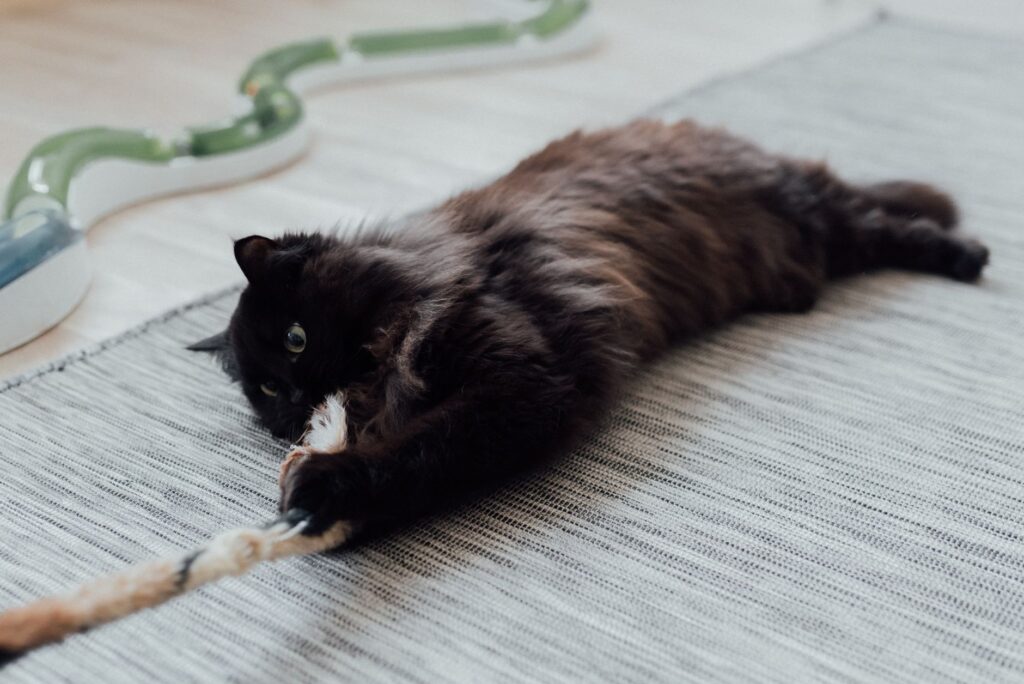
If you’ve ever handed your cat a fresh bag of catnip and gotten nothing but a polite sniff in return, you probably assumed you bought a bad batch, or that your cat is just “not a catnip cat.” In most cases, neither is true. The catnip response is inherited, not something every cat has by default, and a cat that shrugs off catnip completely often lights up for a different plant instead.
This guide breaks down catnip, silvervine, valerian root, and honeysuckle wood, what actually causes the reaction in each one, why some cats respond to one but not another, and which is worth trying first if catnip has never worked in your house.
Why some cats ignore catnip
Catnip (Nepeta cataria) triggers its famous rolling, rubbing, and head-shaking response because of a compound called nepetalactone, which cats detect through scent receptors in their nose. But not every cat has the biology to respond to it. Sensitivity to catnip is an inherited trait, and researchers commonly cite that around one in three cats simply doesn’t respond to it at all, regardless of the brand, freshness, or how it’s offered. Kittens under about three to six months old also typically don’t react yet, since the response tends to develop with age.
So if your cat ignores catnip, it’s not a training failure or a product problem. It’s genetics. The good news is that cats who don’t respond to nepetalactone often do respond to other plants that work through a different chemical pathway.
Silvervine (matatabi): the alternative that works on more cats
Silvervine, also called matatabi, comes from a plant native to mountainous parts of Asia (Actinidia polygama) and is typically sold as dried sticks, dried fruit galls, or a ground powder. Instead of relying only on nepetalactone, silvervine contains a mix of compounds including actinidine, iridomyrmecin, and related iridoids, which appear to interact with cats through a broader chemical pathway than catnip does.
That difference matters in practice. Research on domestic and feral cats has found that a large majority, around 80 percent, respond to silvervine, and notably, most cats who don’t respond to catnip at all still react to silvervine. The reaction also tends to be more intense and can last a bit longer than a typical catnip session, with rolling, drooling, chewing, and rubbing being common.
Because silvervine is usually sold as a chewable stick or a powder to sprinkle on toys, it also doubles as a dental chew for cats that like to gnaw, which catnip generally doesn’t offer in the same way.
Valerian root: a third option worth trying
Valerian root (Valeriana officinalis), better known to humans as an herbal sleep aid, has the opposite effect on many cats. Instead of calming them down, it tends to trigger a stimulating, catnip-like response of rolling, rubbing, and playfulness. The same responsiveness study found that roughly half of cats respond to valerian, and it can work on some cats that don’t respond to catnip at all.
Valerian tends to have a stronger, more medicinal smell than catnip, which some owners find less pleasant to have around the house, but it’s a reasonable option to rotate in if you want variety or if catnip alone isn’t landing.
Honeysuckle wood: the lesser-known fourth option
Tatarian honeysuckle (Lonicera tatarica) wood is the option most cat owners have never heard of, but it’s a real and well-documented one. Sold as small wood chunks or sticks, it triggers a similar response profile to valerian, with roughly half of cats reacting to it, including some non-responders to catnip. Because it’s a solid piece of wood rather than a loose herb, it also holds up well as a long-lasting chew toy or a component to combine with silvervine in a scratcher or wand toy.
Is any of this safe?
Yes. Catnip, silvervine, valerian root, and honeysuckle wood are all generally considered safe, non-toxic, and non-addictive for cats when used for recreational sniffing, chewing, or rolling. The response is a short-lived behavioral reaction, typically lasting somewhere from a few minutes to around 15-30 minutes, followed by a temporary lack of interest as the cat’s sensitivity resets. There’s no evidence any of these builds dependence the way the word “addictive” implies in humans. As with anything a cat chews on, keep an eye on portion size, and if your cat has a known sensitivity or health condition, it doesn’t hurt to mention it to your vet before introducing something new.
FAQ
Why doesn’t my cat react to catnip at all?
The catnip response depends on an inherited sensitivity to nepetalactone, and commonly cited estimates put the number of cats who lack this sensitivity at around one in three. It has nothing to do with the product or how you offer it. Kittens under a few months old also usually don’t react yet, since the response develops with age.
If my cat ignores catnip, will it definitely respond to silvervine?
Not guaranteed, but the odds are good. Research on cats that don’t respond to catnip found that most of them still reacted to silvervine, since it works through a different combination of compounds than nepetalactone alone.
Is silvervine stronger than catnip?
Many cats do show a more intense and longer-lasting reaction to silvervine than to catnip, though individual responses vary. It’s not “more addictive,” just a different and often more potent stimulus for a given cat.
Can I give my cat catnip, silvervine, and valerian all in the same week?
Yes. None of them are considered addictive, and rotating between them is a common way to keep a cat’s interest in toys and scratchers fresh, since a cat’s sensitivity to any one of them temporarily dulls with repeated exposure.
Is silvervine safe for kittens?
Kittens generally don’t show a strong response to any of these plants until they’re a few months old, and most sources treat silvervine as safe for cats of all ages in reasonable amounts. If you’re unsure, it’s fine to ask your vet before introducing it to a very young kitten.