

“GPS tracker for cats” gets used as a catch-all term online, but the three products people usually mean when they say it work in genuinely different ways. A real GPS collar, an Apple AirTag clipped to a collar, and a radio-frequency locator like Tabcat all help you find a cat, but they rely on different technology, different costs, and different real-world limits. Picking the wrong one for your situation is the most common mistake we see in this category, so this guide leads with the technology differences before it gets to specific products.
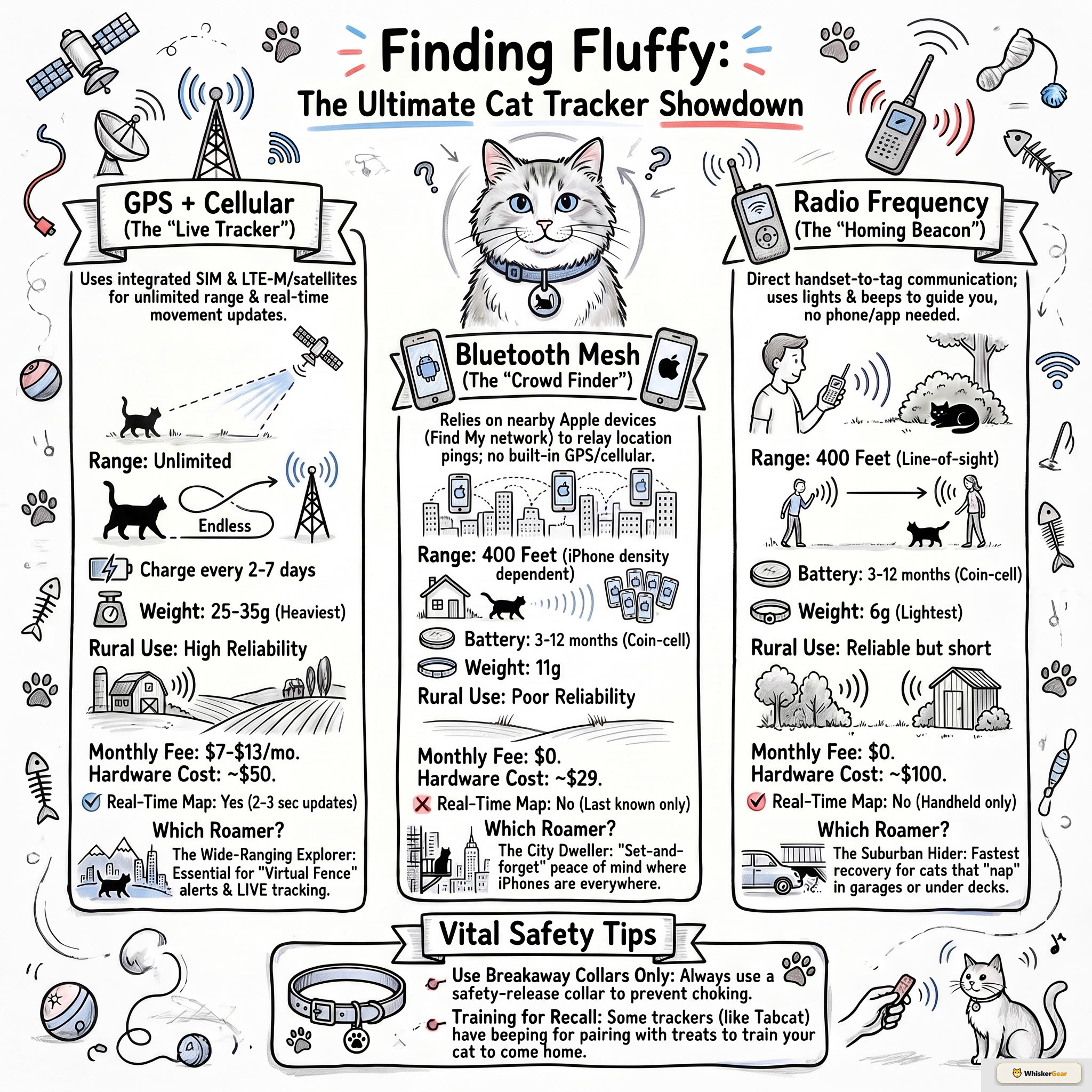
Quick comparison
| Tracker | Technology | Subscription needed | Live map tracking | Typical range |
|---|---|---|---|---|
| Tractive GPS | Cellular GPS/LTE | Yes | Yes, near real time | Anywhere with cell coverage |
| Apple AirTag (collar holder) | Bluetooth + Find My crowd network | No | No, last-seen pings only | Depends on nearby iPhones |
| Tabcat RF locator | Radio frequency, handset to tag | No | No, direction and distance only | Up to around 150 m, line of sight |
1. Tractive GPS Cat Tracker: true real-time GPS tracking [1]
Tractive’s cat tracker has a built-in SIM that connects to cellular networks the same way a phone does, which is what lets it report your cat’s location on a live map from basically anywhere with coverage. That’s the main thing that separates it from the other two options here: it doesn’t depend on being near your phone, another Apple device, or a short-range signal. The tradeoff is that it needs a subscription plan to keep the SIM and data connection active, and battery life is shorter than a passive tag since it’s actively transmitting.
Based on a verified Amazon buyer’s review
2. Apple AirTag in a cat collar holder: Find My network tracking, no subscription [2]
An AirTag is not a cat tracker on its own. It’s a small Bluetooth tag that broadcasts a signal, and any nearby iPhone with Find My enabled quietly relays its approximate location to you, anonymously and without the phone’s owner knowing. A silicone or hard-shell collar holder is what makes it wearable on a cat, but it doesn’t add any GPS hardware. That means it works very well in a neighborhood with a lot of iPhones around, and much less reliably in a rural area or somewhere Android phones dominate. There’s also no live map, just a last-known location with a timestamp.
Note: the holder itself doesn’t include an AirTag. You’ll need to buy an Apple AirTag separately if you don’t already have one.
3. Tabcat RF Pet Tracker: radio-frequency locator for close-range searches [3]
Tabcat works completely differently from the other two. A small tag on the collar responds to a signal from a handheld receiver, and the handset’s lights and beeps get more urgent as you get closer, guiding you to the cat step by step within roughly 150 meters of line-of-sight range. There’s no app, no live map, and no monthly fee. It’s built for the “my cat is hiding somewhere in the house or yard and I need to find it right now” situation rather than for tracking a cat that’s wandered far from home or gone missing for days.
How we chose these trackers
We researched and compared the specifications, official documentation, and manufacturer support pages for each of these three products rather than ranking them by marketing claims. Because they solve overlapping but different problems, we focused less on picking a single “winner” and more on making the technology differences clear enough that you can match a tracker to how your cat actually roams.
How to choose
- If your cat roams far, goes missing for hours or days, or you want alerts when it leaves a set area, a cellular GPS tracker like Tractive is the only option here that actually delivers that.
- If your cat mostly stays close to home in a dense neighborhood and you just want a low-cost safety net, an AirTag in a collar holder can work well, especially if you or your neighbors carry iPhones.
- If your cat tends to hide indoors, in the yard, or nearby, and you want a zero-subscription tool to physically walk toward it, an RF locator like Tabcat is built exactly for that.
- Battery habits matter: GPS trackers need charging every few days, AirTags need a coin battery swap roughly once a year, and RF tags need small batteries changed every several months.
- Consider combining tools. Some owners run an AirTag for everyday peace of mind and keep a GPS tracker in reserve for outdoor cats with more freedom to roam.
Sources
Each link below points to the same Amazon listing cited for that pick above.
- Tractive GPS Cat Tracker: true real-time GPS tracking
- Apple AirTag in a cat collar holder: Find My network tracking, no subscription
- Tabcat RF Pet Tracker: radio-frequency locator for close-range searches
FAQ
Is an AirTag as good as a real GPS tracker for a cat?
Not in the way most people mean by “GPS tracker.” An AirTag reports a location only when a nearby Apple device happens to detect it and relay that data, so there’s no continuous live map and no guarantee of a fast update if your cat is somewhere with few iPhones around.
Do GPS cat trackers work without a monthly subscription?
Cellular GPS trackers like Tractive generally require an active subscription because the tracker itself has a SIM card using mobile data to send location updates, and that connectivity has an ongoing cost. Trackers that avoid subscriptions, like AirTags or RF locators, use different technology with shorter range or dependence on nearby devices instead.
How far can a Tabcat RF tracker actually reach?
The manufacturer lists a range up to roughly 150 meters in open, line-of-sight conditions. Walls, doors, and other obstructions reduce that range, so it’s best thought of as a tool for finding a cat that’s relatively close by, not one that’s wandered far from home.
Will any of these trackers work if my cat loses its collar?
No. All three rely on the tag or tracker staying attached to the cat, usually via a breakaway collar for safety. A cat that slips its collar and loses the device becomes untrackable until it’s found by other means, which is worth keeping in mind alongside a microchip as a backup form of identification.
Can I use more than one tracking method at the same time?
Yes, and some owners do exactly that, for example using an AirTag day to day and reserving heavier reliance on a GPS subscription for periods when a cat has more outdoor access or a history of wandering.
The verdict
None of these three products is a straight upgrade or downgrade of the others, because they’re not really solving the same problem. Tractive is the one true live GPS tracker of the group and the only one built for a cat that genuinely roams or goes missing for extended periods, at the cost of a recurring subscription. An AirTag in a cat collar holder is the cheapest ongoing option and can be a reasonable safety net in an iPhone-dense neighborhood, but it’s not live tracking and its usefulness varies a lot by location. Tabcat sits in its own lane entirely: a subscription-free tool built specifically for locating a cat that’s nearby but hiding, not for tracking one that’s far away. The right choice comes down to how your specific cat behaves, not which product has the flashiest spec sheet.