
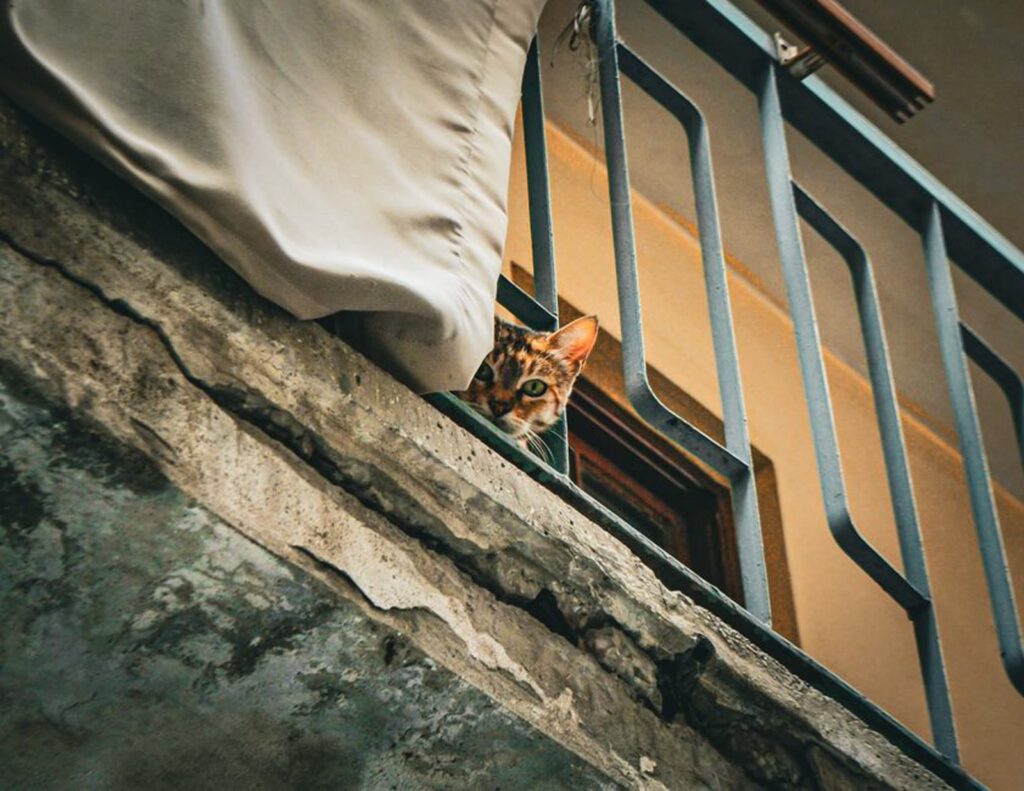
A screened balcony solves the falling problem. It doesn’t automatically become somewhere your cat wants to be — and it’s common to spend money on netting only to find they still prefer the sofa. What’s missing is almost never space. It’s height, shade and wind.
Why cats ignore the balcony
A balcony is usually a rectangle of empty floor, exposed to sun, with nothing raised on it. To a cat that’s the opposite of what they’re looking for: they want a high vantage point with a wide view and an escape route. Hot, flat ground offers neither.
The thing that changes everything: something to climb
A shelf, a stool or a vertical scratching post against the railing transforms the space. From up there they can see the street, the birds and the movement — which is exactly what sent them to the window in the first place.
If the balcony gets strong sun, the high spot needs to be in the shaded part, or it’ll only be used early in the morning.
Shade isn’t a luxury
Cats seek warmth, not heatstroke. A balcony in full sun becomes an oven by midday, and a pale-coated cat or one with white ears runs a real risk of burns — and, over years, of squamous cell carcinoma, which is more common on unpigmented ears and noses.
An awning, a bamboo blind or a tall plant solves it. The cat will choose where to sit, as long as there’s a choice.
Water changes how long they stay
Few people put water on the balcony, and it’s the difference between a ten-minute visit and a whole afternoon. If they have to come inside to drink, there’s a good chance they won’t go back out.
Plants: check what’s already out there
Balconies are where the household plants usually live, and several of the most common ones are toxic to cats. Lilies are the worst case — a small amount can cause acute kidney failure. Dieffenbachia, snake plant and anthurium are also on the irritant list.
Safe alternatives that still keep the balcony green: cat grass, rosemary, basil and areca palm.
The mistake that cancels out the netting
Furniture pushed against the railing on the outside of the mesh, or a chair that works as a step to the top of the netting where it ends. Check it with the cat out there: they’ll test the highest point they can reach, and it’s always the one you didn’t think of.
Adjusting the setup across the seasons
A balcony that’s perfect in spring can become unusable in summer and uncomfortable in winter if the setup never changes. In hot months, check the shaded spot at the actual time your cat wants to be out there — shade at 9am doesn’t mean shade at 2pm, since the sun moves and the “safe” corner in the morning can be the hottest by afternoon. Concrete and metal surfaces also hold heat well after direct sun has moved off them, so a paw-test (if it’s too hot for the back of your hand held on the floor for a few seconds, it’s too hot for paw pads) is worth doing before assuming a shaded spot is actually cool. In colder months, cats — especially kittens, seniors, and short-haired breeds — lose interest in the balcony fast if there’s nowhere warm to retreat to nearby; leaving the door cracked so they can come in and out on their own beats trying to guess when they want inside.
Introducing a new or nervous cat to the space
Not every cat walks onto a screened balcony and immediately understands it’s safe. A cat that’s never had outdoor access, or one that’s naturally anxious, often needs a supervised introduction: open the door, let them approach at their own pace, and stay out there with them the first several times rather than assuming the screen alone makes it safe to leave them unsupervised right away. This is also a good moment to double-check the netting yourself from the cat’s likely vantage points — sit or crouch near the areas they’re drawn to and look for any gap, loose corner, or step-up point you might have missed during installation. A slow introduction costs a few days; a screen with an overlooked gap can cost a lot more.
Frequently asked questions
Can I leave my cat alone on a screened balcony?
Yes, as long as there’s shade, water and no foothold that takes them above the mesh. For the first few days, watch where they climb.
Does a screened balcony replace walking a cat outside?
For most cats, yes. It delivers what they’re actually after — outdoor smells, movement and a lookout — without the stress of the street.
Which plants should I avoid?
Lilies are the most dangerous, with a risk of acute kidney failure. Also avoid dieffenbachia, anthurium, snake plant and azalea.
What if the balcony is very small?
Size matters less than height. A narrow shelf three feet off the ground already creates a place the cat uses every day.
Can cats get cold on a balcony in winter?
They can, especially kittens, seniors and short-haired cats. Leave the door open enough for them to decide when to come in.